Kameoka Natural Grinding Stone Museum
I have accumulated a number of lovely hand-crafted leather knives over the years but one area I’ve been poor at is properly sharpening them. I’ve maintained their edges by continual stropping but eventually the edges need to be re-sharpened. I was some§what fearful of ruining them with ham-fisted DIY sharpening so sent off a few to be sharpened by a knife making company based in Hampshire. Although I was underwhelmed when they were returned and decided not to send them my most precious knives!
The area around Kameoka, 15 miles West of Kyoto, is renowned for their whetstones or water stones. The area has mined the stones for centuries initially to sharpen Samurai swords but latterly Japanese kitchen knives. The mining stopped in the 1960s as man made ceramic stones could be produced more economically. So their wet stones are becoming more scarce.
The Kameoka Natural Grinding Stone Museum offer classes to learn how to sharpen knives using water stones. Armed with my Crimson Hides flush cut knife, I headed off to learn how to sharpen it. The course was taken by the museum’s director, Aki Tanaka, and the Master sharpener.

Aki demonstrating how to sharpen a double sided kitchen knife

Double sided blades generally have an initial bevelled edge with a second bevelled edge, typically at 17-20 degrees. There’s a trade off between having a sharper shallower angle and the durability of maintaining a sharp edge. Japanese knives also have a harder core with softer steel on each side.

The leather flush cut knife only has a bevelled edge on one side. However the flat side of my Crimson Hides knife was more curved at the edge.

An exaggerated diagram if my cut knife shows the flat sided profile in yellow. To properly sharp it needed metal below the red line to be removed in order to return it to a flat edge

The museum’s master sharpener tackled much of the fettling of the knife’s flat edge.

Quite a lot of metal was needed to properly sharpen the knife but it is now razor sharp and slices through even stiff leather with ease.

Having been taught to sharpen knives properly it made sense to use up the spare luggage allowance with some sharpening stones (left to right): Metal 600grit Dyamond for heavily damage knives and flattening the other stones, Suehiro Cerax ceramic 1000grit stone, Aoto 2400grit and Awasedo 6000-8000grit. The latter two mined from the local Kameoka area..
Michelle Loves Leather and tannery
The area around Himeji is known for its leather so it was an ideal opportunity to make a visit to a tannery. Sadly there’s only one tanneryf left in the UK, J & FJ Baker, down in Devon. Therefore it’s not possible to see the tanning process firsthand.
The company visited was Michelle Loves Leather which is a leather retailer attached to a tannery. Their manager, Kurumi, was very kind to give a short guided tour of the tannery. It also enabled me to purchase a half hide from their Savoie range (shrunken & embossed) in colour Rubi to make a bag once back in the UK.

First the raw hides are washed in large drums to remove all the dirt

Once cleaned, hair and fat are removed from the hides in drums containing a lime pickle

The hides are cut in two along the line of the back bone and split to the desired thickness before starting the chrome tanning process

The hides are tumbled in drums containing chromium salts. A process that only takes between 8 hours to a full day, compared to veg tanning which takes months. The chromium attaches to the collagen fibres which preserves the hides and also makes them supple and water-resistant.

Removing the chromed tanned hides. The hides take on a light blue colour due to the presence of the chromium.

These drums are used to dye the tanned hides. In this case a dark brown.

Laying out the dyed hides from the dying drums.

Drying the hides on the second floor above the tanning drums.

The tanned hides are then processed by a number of other local firms depending on the desired finished product, eg surface embossing to imprint a more uniformed ‘bubble’ texture.

The Michelle Loves Leather shop above the tannery contained small leather pieces all the way up to half hides.

The leather shop is really tastefully decorated, so different from the warehouse approach of most UK retailers.

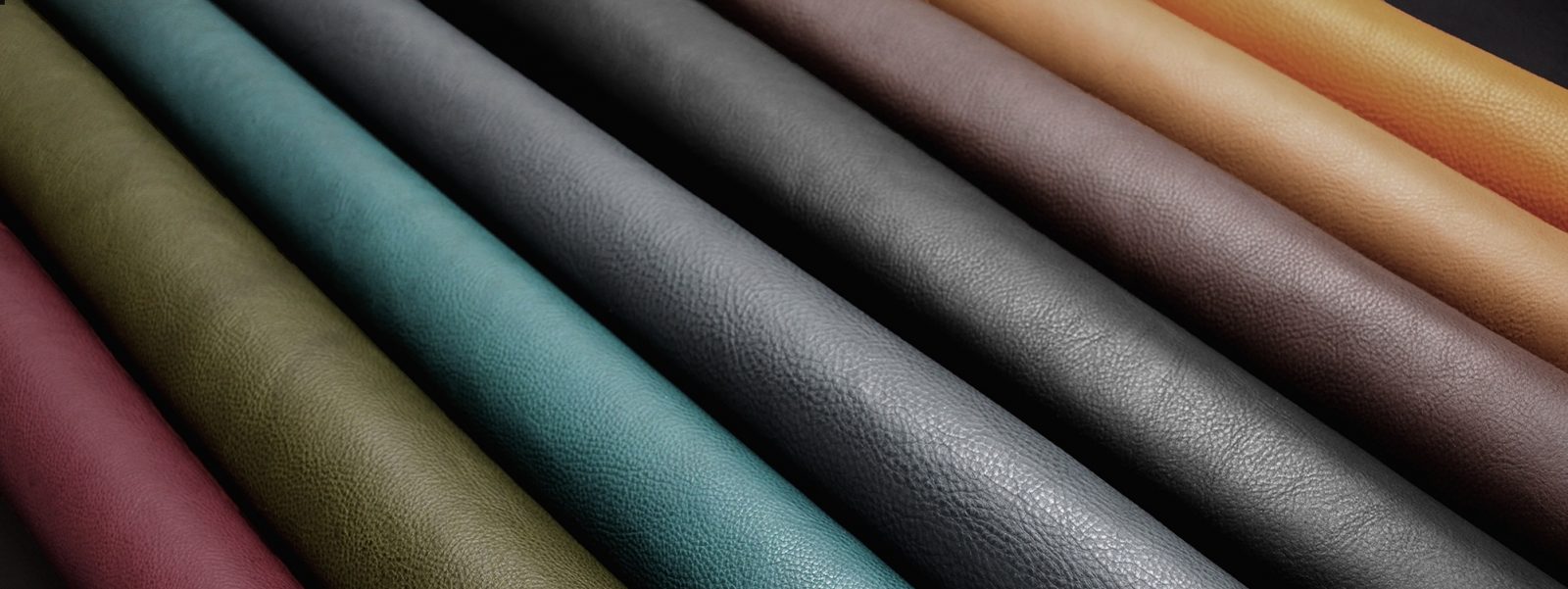
The array of vibrant leather colours available in chrome tanned. I generally only use veg-tanned leather but chrome tanned produces a softer leather which might be better suited to a bag I was thinking of making.

Rolls of various hides from rolled smooth, bubble embossed to natural finishes.
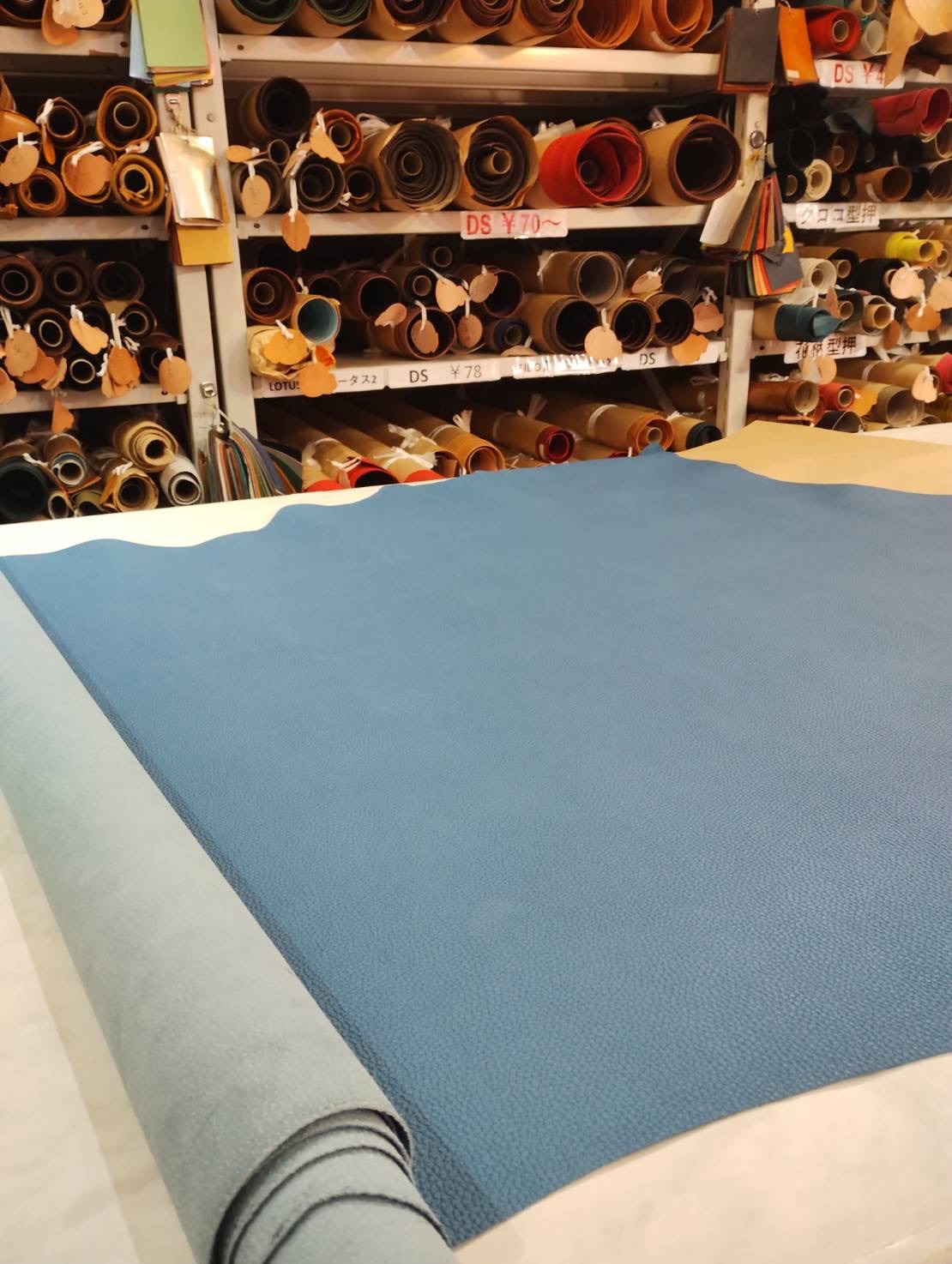
Their Rubi light blue hide was chosen. I just need to work out how to get it back to the UK without creasing or damaging it!

The design of the intended bag.
Japanese Swordsmiths
No visit to Japan would be complete without visiting their renowned highly skilled swordsmiths and the opportunity to buy a suitable souvenir knife. Almost all now mainly produce kitchen and specialist knives rather than Samurai swords. A flush cut knife was source from the Takefu Knife Village and a skiving knife from the Masamune Sword and Blade Workshop, run by a 25th generation swordsmith.
The History of Masamune Kogei
About 700 years ago, the regent, Hojo family, invited swordsmiths from across the country to Kamakura, which was the capital of Japan (1185-1333). Together they contributed to establishing the basic techniques. and skills of Kamakura style Katana forging that is called Soshu-den.
Gora Nyudo Masamune, the founder of Soshu-den style was born in Kamakura, a son of swordsmith Yukimitsu. Yukimitsu was presumed to have been from the Kyoto Awataguchi style of sword making. Masamune developed his own style known for his outstanding techniques that met the warriors demand for Katana at that time.
Five generations after the first Masamune, his successor was Hiromasa, also known as Tsunahiro, a name given to him by the Odawara Hojo clan. His successor was invited to Odawara by the powerful lord of the Hojo family.
He was given the name of Tsuna from Hojo Ujitsuna and named himself Tsunahiro. During the time of Tokugawa shogunate, the descendents of Tsunahiro were invited by the Tokugawa family to be their official swordsmith and continued to make the Masamune brand of Katana swords.
In the Showa Period, Masamune artisans started to make kitchen knives and other kinds of steel handcrafts such as shears and other edged tools in addition to Katana.

The Masamune skiving knive and Takefu Flush Cut Knife.

The Masamune Sword and Blade Workshop in Kamakura.

Takamasa (Masamune XXV) was kind enough to provide a tour os the small workshop. Traditionally an apprentice would hammer the heated steel however an electric now performs this task.

The worker pit, furnace and hammering machine.

The workshop has its own well (covreed with bamboo) for quenching the blades.